
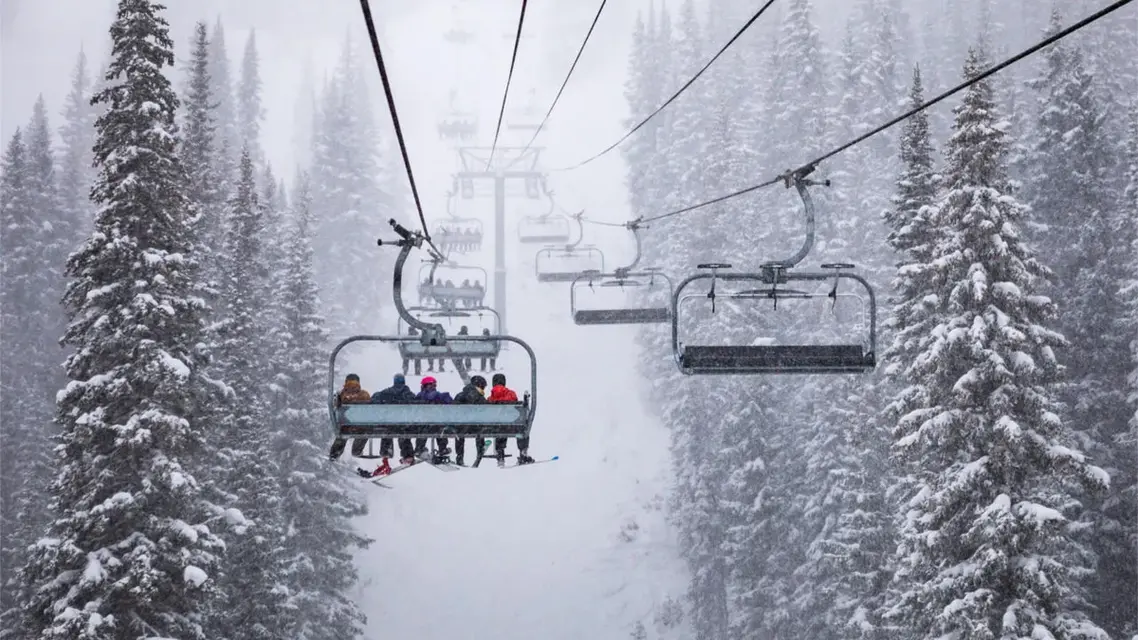
Snow in Vail falls mostly from November through April. In the town, January and February are the snowiest months at about 35 inches each, November and December run 26 to 28 inches, and a full year averages about 189 inches. October brings under 9 inches on average and May under 5, and June through August bring almost none.
Snowfall and temperature by month
The figures are the National Oceanic and Atmospheric Administration's 1991-2020 climate normals for its Vail, Colorado station, at 8,304 feet. A snow day is a day with an inch or more of snow.
| Month | Average snowfall (inches) | Snow days per month | Average high / low (F) |
|---|---|---|---|
| January | 35.3 | 10.3 | 28.5 / 6.6 |
| February | 35.7 | 9.9 | 33.0 / 9.2 |
| March | 28.2 | 8.2 | 41.7 / 16.7 |
| April | 21.2 | 6.6 | 49.4 / 23.8 |
| May | 4.8 | 1.8 | 60.4 / 31.0 |
| June | 0.6 | 0.2 | 71.4 / 35.6 |
| July | 0.0 | 0.0 | 76.7 / 41.6 |
| August | 0.0 | 0.0 | 74.0 / 40.8 |
| September | 0.9 | 0.5 | 66.6 / 34.0 |
| October | 8.6 | 3.1 | 54.1 / 25.2 |
| November | 25.9 | 7.8 | 37.7 / 15.1 |
| December | 28.0 | 8.9 | 28.0 / 7.1 |
From December through February about one day in three brings an inch or more of snow, and March is close behind. Winter highs sit near 30 degrees and lows near 7, so layers matter; see how to dress for Vail. April is still a snow month, with 21 inches on average and about one snow day in five.
Year-to-year swings
An average hides wide seasons. The Western Regional Climate Center's record for the same Vail station, covering the winters from 1984-85 to 2012-13, shows complete seasonal totals from 122 inches to 280 inches, and January 1996 alone brought 92.5 inches. The lowest temperature from 1985 to 2012 was minus 32, on February 2, 1985. Plan around the normals, not around a single storm.
The town versus the mountain
The 189-inch figure belongs to the station in town. Vail Mountain reports an average of 354 inches, nearly double, on slopes that run from 8,120 feet at the base to 11,570 feet at the top. The town normals show how the year is shaped; the mountain figure is the resort's own estimate for the ski terrain.
The edges of the season
Measurable snow is rare in September (0.9 inches) and modest in October, and May still averages 4.8 inches. When the lifts turn is the resort's decision, not a snowfall threshold. How early Vail gets snow and when Vail Mountain opens for the season cover the start, and the best time to go to Vail weighs snow against crowds and prices.
Driving when it snows
The Colorado Department of Transportation can put a Passenger Vehicle Traction Law or Chain Law into effect on any state highway. Under a traction law, an all-wheel or four-wheel drive vehicle needs snow-rated or winter tires (marked M+S or with the mountain-snowflake symbol) with at least 3/16 inch of tread, or an all-weather rating from the manufacturer, or chains or an approved traction device. Under a chain law, every vehicle must carry chains or an approved device. Not complying costs a $100 fine and a $33 surcharge, rising to $500 and $157 if it closes a travel lane. Alerts appear on highway signs and at COtrip.org. Routes and drive times are in how to get to Vail, and the Town of Vail's buses are free all year if you would rather not drive in a storm. Days without skiing have their own list in what to do in Vail if you do not ski.