
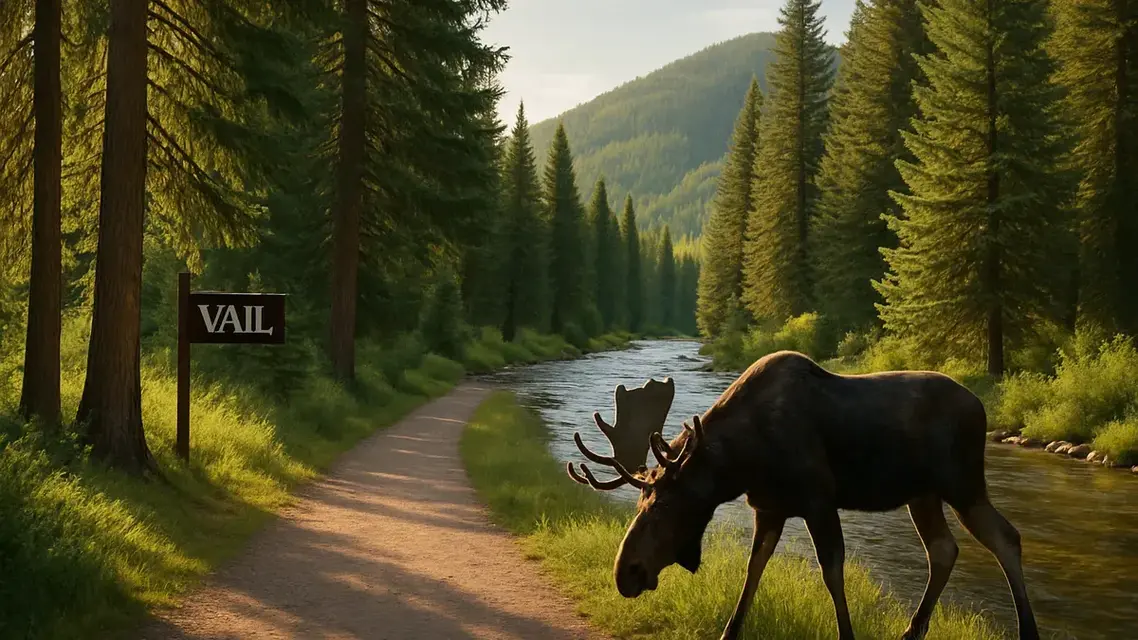
Moose live in the Vail area, but no trail or time of day guarantees a sighting. Colorado now has more than 3,000 moose, following reintroductions that began in 1978, and Discover Vail names Gore Creek in town, the Upper Piney River Trail and the Deluge Lake Trail as places people have seen them. Moose tolerate people far more than most wildlife does, and that is what makes them dangerous at close range. Watch from a distance, keep dogs on a leash and back away as soon as an animal reacts to you.
Where moose have been seen near Vail
| Area | What to know |
|---|---|
| Gore Creek, through town | A mother moose and calf have been seen cooling off near the water, alongside deer and black bears, mostly in summer. The creek runs through the middle of Vail, so a sighting can happen close to the villages. |
| Upper Piney River Trail and Piney Lake | The moderate 6-mile out-and-back hike to Upper Piney River Falls starts just outside the entrance to Piney River Ranch, about 12 miles from Vail. Moose are among the animals hikers may see, along with deer, bears and marmots. The unpaved Forest Service road to the ranch, Red Sandstone Road, takes about 45 minutes and does not need four-wheel drive. The ranch is open seasonally, typically from June 21 to the last weekend of September. More trails are in the Vail hiking guide. |
| Deluge Lake Trail | A difficult trail into the Eagles Nest Wilderness, with boulder fields and summer wildflowers. Mountain goats, marmots and moose have all been seen along it. |
How to look for moose
Colorado Parks and Wildlife (CPW) publishes general guidance for finding moose:
- Find a high spot that looks down into drainages, or drive slowly along logging roads on national forest land that run beside them.
- Look along the edges of willow bottoms and aspen or pine forest for large tracks, droppings and browsed willows.
- Try near water. Moose are excellent swimmers and at home in it.
- Do not expect a herd. Moose travel alone or in small family groups, even in winter.
- Watch and photograph with binoculars, a spotting scope or a telephoto lens, never by walking up to the animal.
When moose are most protective
| Time of year | What to expect |
|---|---|
| Mid-May to early June | Calves are born. Cows are protective and more likely to act aggressively toward people, and especially dogs, well into summer. Avoid thick willows and keep dogs on a leash. |
| Late September through November | Breeding season. Bulls can become aggressive and territorial, so take extra care. |
| Winter | Moose are not frightened by snowmobiles, ATVs or vehicles and often use packed trails to avoid deep snow. They may stand their ground and possibly charge. If one is on your trail, use another route or give it time to leave. |
Distance, warning signs and dogs
There is no fixed distance for moose: if a moose reacts to your presence, you are too close. Warning signs include laid-back ears, raised hair on the neck, a lowered head, swaying, licking the snout, and rolling the eyes and ears back. For scale, Vail's general wildlife rule is at least 25 yards from animals such as elk and 100 yards from predators such as bears. Treat 25 yards as the minimum for a moose, not a target.
Moose can run up to 35 miles per hour. If one charges, run as fast as you can and put something large between you, such as a boulder, car or tree. Moose treat dogs as they would a wolf, and conflicts involving dogs have caused serious injuries to people and pets, so CPW recommends keeping dogs leashed and under control in the backcountry or leaving them at home. On every trail that enters the Eagles Nest Wilderness, dogs must be on a physical leash. For places dogs are welcome, see dog-friendly activities in Vail. A moose that behaves dangerously toward people should be reported to CPW.
If Vail does not deliver
Most moose live in forests, where they are hard to count, so reliable population figures are limited. Colorado's legislature designated Walden, in North Park, the Moose Viewing Capital of Colorado in 1995. Closer to home, the Vail Nature Center runs wildflower walks, campfire talks and creekside nature tours, and the camping guide covers overnight options in the forest around Vail.