Vail Mountain is owned and operated by Vail Resorts, Inc., a publicly traded company listed on the New York Stock Exchange as MTN and based in Broomfield, Colorado. No single person or family controls it: the shares are held by investors, and the largest holders are investment managers. The land is a separate question. Vail's trails and lifts sit on White River National Forest, and Vail Resorts runs them there under a U.S. Forest Service permit, so the public still owns the mountain itself.
Who holds the shares
Because the company is public, ownership means stock. The company's proxy statement of October 30, 2025 names four holders of more than 5 percent of the stock, measured against 35,953,208 shares outstanding on October 14, 2025.
| Holder | Shares | Share of class |
|---|---|---|
| Baron Capital Management (Ronald Baron) | 5,185,136 | 14.4% |
| Capital International Investors | 4,984,025 | 13.9% |
| The Vanguard Group | 3,798,088 | 10.6% |
| BlackRock, Inc. | 3,484,986 | 9.7% |
Together those four hold about 49 percent. Their positions come from Schedule 13G filings dated between February 2024 and August 2025, so today's figures may differ, and shares change hands daily. The people who run the company own little by comparison. Chairperson and CEO Robert Katz, who took the role on May 22, 2025 in succession to Kirsten Lynch, held 247,812 shares, and the company's 15 directors and executive officers together held 418,453, about 1.2 percent. For the wider debate over what corporate ownership means for ski towns, see corporate consolidation and ski towns, and for company value, how much Vail Resorts is worth.
The company behind the mountain
Vail Resorts was organized as a holding company in 1997. In the fiscal year ended July 31, 2025 it took in about $2.96 billion in net revenue, 89 percent of it from the Mountain segment, with the rest from Lodging and a sliver from Real Estate. Its quarterly report for the period ended April 30, 2026 counts 42 destination mountain resorts and regional ski areas in the United States, Canada, Switzerland and Australia. Vail Mountain is the flagship: the annual report calls it the second most visited mountain resort in the United States for 2024/25, with about 5,300 skiable acres including the seven back bowls and Blue Sky Basin. The rest of the portfolio is covered in what resorts Vail owns and how many mountains it owns.
The land under the lifts belongs to the public
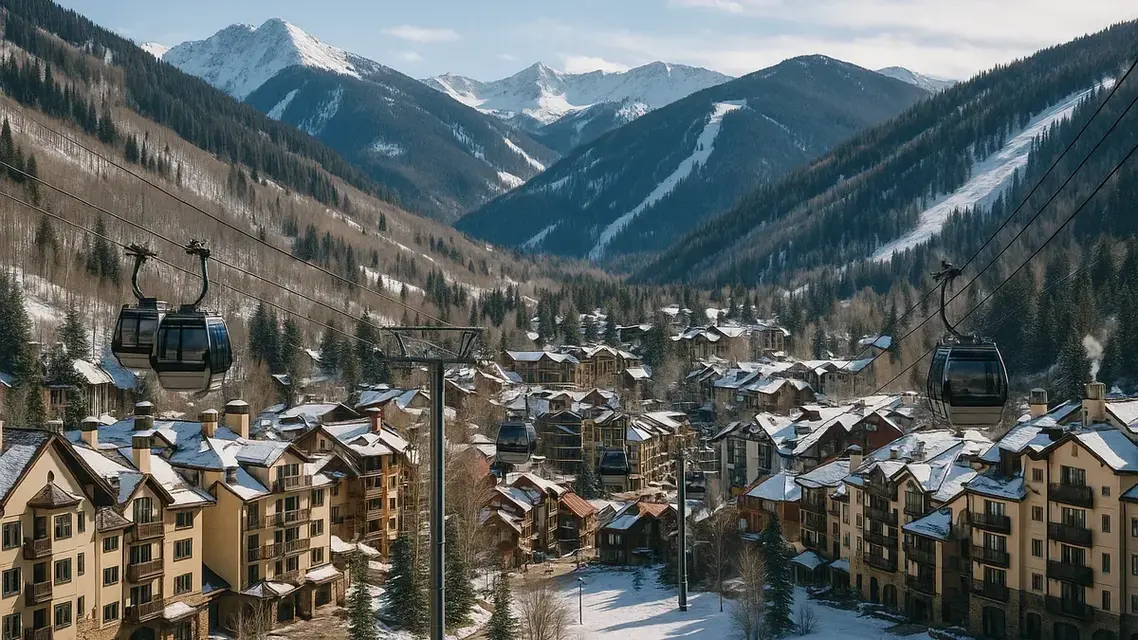
Vail Mountain operates on land under the U.S. Forest Service, through a term Special Use Permit that covers 12,353 acres and expires December 1, 2031. Vail Resorts expects to request a new permit before then, and says it is not aware of the Forest Service ever refusing to replace an expiring permit for a ski resort in operation. The agency can also end a permit if it decides that is required in the public interest. The company's property table lists Vail Mountain twice: as an owned property (resort operations, lifts, trails and other improvements, commercial space and real estate held for sale or development) and as the 12,353-acre permit area. The accurate answer therefore has two parts. Vail Resorts owns and runs the ski business, its improvements and some property, while the terrain itself is national forest land used under a permit.
How Vail came to be a public company
| Year | Ownership and company milestones |
|---|---|
| 1962 | Pete Seibert, a 10th Mountain Division veteran, and Earl Eaton, an Army engineer, found Vail Mountain, which opens with two chairlifts and one gondola. |
| 1985 | George Gillett buys Vail and Beaver Creek and begins installing high-speed detachable chairlifts. |
| 1992 | Gillett Holdings, the predecessor of Vail Resorts, Inc., emerges from bankruptcy on October 8. |
| 1997 | Vail Resorts goes public on February 7, opening on the NYSE at $23.50 with Vail, Beaver Creek, Breckenridge and Keystone. |
| 2008 | The Epic Pass launches, giving access to several resorts at one price. |
| 2012 to 2016 | Afton Alps and Mt. Brighton join in 2012; Park City Mountain is bought in 2014 after Canyons Resort (2013); Perisher in Australia follows in 2015 and Whistler Blackcomb in 2016. |
| 2017 | A pledge to reach a zero net operating footprint by 2030. |
| 2022 | A $175 million investment in employees raises the minimum wage by an average of 30 percent, to $20 or $21 an hour; Andermatt-Sedrun becomes the company's first strategic investment in a European resort. |
The founding and IPO dates each have a longer story in when Vail Resorts was founded, how old Vail Ski Resort is and how Vail acquired Park City.
Who runs what else in Vail
Owning the mountain does not mean owning everything a visitor touches.
| What | Who runs it |
|---|---|
| Vail Mountain lifts and lift tickets, including the Epic Pass | Vail Resorts |
| Town parking structures and lots, and the free in-town buses | Town of Vail (see where to park at Vail) |
| Vail Nordic Center and the golf course | Vail Recreation District |
| Nature Discovery Center at the top of Eagle Bahn | Walking Mountains Science Center, a nonprofit |
| Land under the ski trails | U.S. Forest Service, under a permit |
The Town of Vail is a separate municipal government led by a seven-member town council. Lift tickets and passes are sold by Vail Resorts; for prices, see Vail lift ticket prices.